Quatbody#
- class c4dynamics.states.lib.quatbody.quatbody(x=0, y=0, z=0, vx=0, vy=0, vz=0, phi=0, theta=0, psi=0, p=0, q=0, r=0, quat=None)[source]#
A rigid-body object with a quaternion attitude
The
quatbodyis the quaternion replicate of therigidbody. It extends thedatapointclass to form an elementary rigidbody object in space, i.e. an object with length and attitude, where the attitude is represented by a unit quaternion rather than by Euler angles.The dynamics model is the same model of the
rigidbody. However, the Euler angles kinematics are singular at \(\theta = \pm 90°\) (gimbal lock), while the quaternion kinematics are not. This makes the quatbody suitable for agile vehicles, such as drones, that may reach any attitude (e.g. flips).Its state vector consists of the following variables:
\[X = [x, y, z, v_x, v_y, v_z, q_w, q_x, q_y, q_z, p, q, r]^T\]Position coordinates, velocity coordinates.
Attitude quaternion (scalar first), angular rates.
The quaternion \([q_w, q_x, q_y, q_z]\) represents the same attitude as the 3-2-1 Euler angles \([\varphi, \theta, \psi]\) of the
rigidbody(seeeuler2quat). The Euler anglesphi,theta,psiare available as properties that are derived from the quaternion.Arguments
- xfloat or int, optional
The x-position of the datapoint. Default value \(x = 0\).
- yfloat or int, optional
The y-position of the datapoint. Default value \(y = 0\).
- zfloat or int, optional
The z-position of the datapoint. Default value \(z = 0\).
- vxfloat or int, optional
Component of velocity along the x-axis. Default value \(v_x = 0\).
- vyfloat or int, optional
Component of velocity along the y-axis. Default value \(v_y = 0\).
- vzfloat or int, optional
Component of velocity along the z-axis. Default value \(v_z = 0\).
- phifloat or int, optional
Initial Euler angle representing rotation around the x-axis (rad). Default value \(\varphi = 0\).
- thetafloat or int, optional
Initial Euler angle representing rotation around the y-axis (rad). Default value \(\theta = 0\).
- psifloat or int, optional
Initial Euler angle representing rotation around the z-axis (rad). Default value \(\psi = 0\).
- pfloat or int, optional
Angular rate around the x-axis (roll). (rad/sec). Default value \(p = 0\).
- qfloat or int, optional
Angular rate around the y-axis (pitch). (rad/sec). Default value \(q = 0\).
- rfloat or int, optional
Angular rate around the z-axis (yaw). (rad/sec). Default value \(r = 0\).
- quatarray_like, optional
Initial attitude quaternion \([q_w, q_x, q_y, q_z]\). If provided, it overrides phi, theta, and psi. The quaternion is normalized. Default value: None.
The initial attitude is provided either by Euler angles, as in the
rigidbody, or directly by a quaternion. The vector of initial conditions can be retrieved by callingquatbody.X0:>>> from c4dynamics import quatbody
>>> qb = quatbody(z = 10, psi = 90 * c4d.d2r, r = 0.5)
>>> qb.X0
[0  0  10  0  0  0  0.707  0  0  0.707  0  0  0.5]
Note
The quaternion components are named \(q_w, q_x, q_y, q_z\) (qw, qx, qy, qz) rather than \(q_0, ..., q_3\), since the 0 suffix of a state variable is reserved for its initial value (e.g. q0 is the initial pitch rate, see
state.X0).- Parameters:
mass (float) – The mass of the datapoint
I ([float, float, float]) – An array of moments of inertia
Example
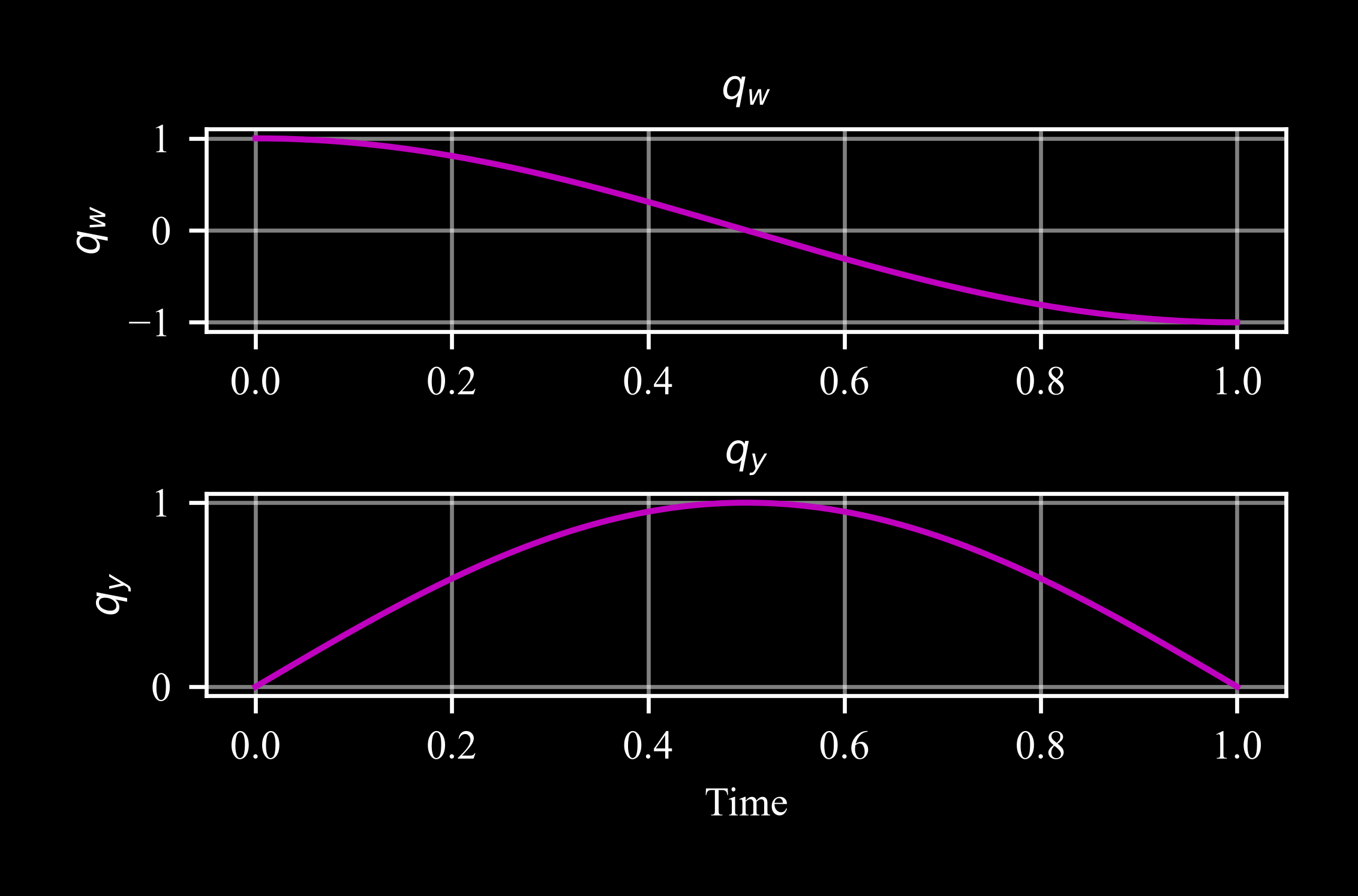
A quadcopter performs a back flip: it starts at a level attitude with a pitch rate of one revolution per second, and rotates freely (no external forces nor moments) for one second.
The Euler angles kinematics of a
rigidbodycross the singularity at \(\theta = 90°\). The quaternion kinematics of the quatbody remain regular along the entire maneuver.import required packages:
>>> import c4dynamics as c4d
>>> from matplotlib import pyplot as plt
>>> import numpy as np
Settings and initial conditions:
>>> dt = 0.001
>>> drone = c4d.quatbody(z = 10, q = 2 * np.pi)
>>> drone.I = [0.0082, 0.0082, 0.0149]
>>> drone.mass = 1.2
Main loop:
>>> for t in np.arange(0, 1, dt):
...   drone.store(t)
...   drone.inteqm(np.zeros(3), np.zeros(3), dt)
After a full revolution the quaternion returns to the level attitude (up to the sign):
>>> drone.store(1)
>>> np.abs(drone.quat)
[1  0  0  0]
The pitch component of the quaternion, \(q_y = sin(q \cdot t / 2)\), goes smoothly through the entire revolution:
>>> _, ax = plt.subplots(2, 1)
>>> drone.plot('qw', ax = ax[0])
>>> ax[0].set(xlabel = '')
>>> drone.plot('qy', ax = ax[1])
The
animatemethod allows the user to play the attitude histories given a 3D model (requires installation of open3D), exactly as with therigidbody.animate.Properties
Gets and sets the object's mass.
Gets and sets the array of moments of inertia.
Gets and sets the attitude quaternion.
Returns an array of Euler angles.
Gets and sets the Euler roll angle, \(\varphi\) (rad).
Gets and sets the Euler pitch angle, \(\theta\) (rad).
Gets and sets the Euler yaw angle, \(\psi\) (rad).
Returns an array of angular rates.
Returns a Body-from-Reference Direction Cosine Matrix (DCM).
Returns a Reference-from-Body Direction Cosine Matrix (DCM).
Methods
quatbody.inteqm(forces, moments, dt)Advances the state vector,
quatbody.X, with respect to the input forces and moments on a single step of time, dt.quatbody.data([var, scale])Returns arrays of stored time and data.
quatbody.plot(var[, scale, ax, filename, ...])Draws plots of trajectories or variable evolution over time.
quatbody.animate(modelpath[, angle0, ...])Animate a rigidbody.